“You have not implemented an affirmative step for ensuring that fish and fishery products you import are processed in compliance with the Seafood HACCP regulation.”
Cited across five separate products.
Read the letter on fda.govFDA’s inspection program tells investigators that if the plan you hold misses a hazard the Hazards Guide lists for that species, your affirmative step is inadequate. Keelsure reads every supplier’s plan against the Guide and cites its work, keeps each supplier-product current, and produces the file an investigator asks for.
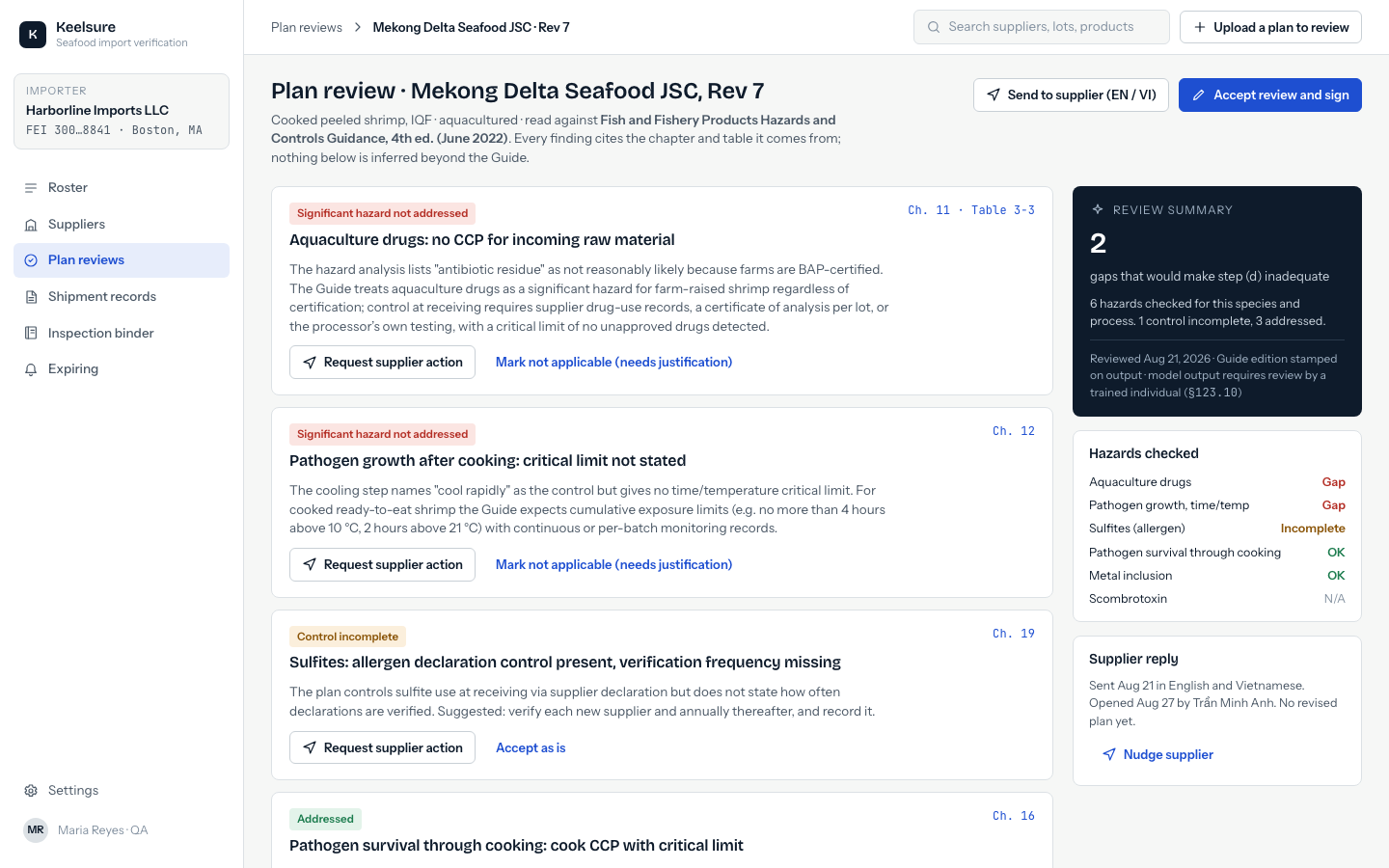
Paste any supplier’s plan. Real findings, cited to the Guide, in minutes. No account, nothing saved, no card.

of inspected importers had compliant written verification procedures and specifications
FDA seafood HACCP evaluation, FY2006–14warning letters to named US seafood importers under §123.12, January to May 2026
FDA warning letter databaseof shrimp entry lines refused for antibiotics in 2026 came from BAP-certified plants
Southern Shrimp Alliance, through August 2026what a consultant charges to review one supplier’s HACCP plan — once
Industry rate guides and practitioner forumsFour public warning letters in five months, to firms from a one-office specialty importer to a Boston house with hundreds of suppliers. None involved unsafe fish. All of them are the first result when a retailer’s compliance desk searches the firm’s name.
“You have not implemented an affirmative step for ensuring that fish and fishery products you import are processed in compliance with the Seafood HACCP regulation.”
Cited across five separate products.
Read the letter on fda.gov“Your written verification procedures do not identify which affirmation step(s) you have chosen to implement” … “was not signed and dated at the time of the activity.”
A repeat of the 2022 inspection. FDA rejected the firm’s response: it acknowledged the violations without documenting a fix.
Read the letter on fda.gov“You do not have or have not implemented an affirmative step … as required by 21 CFR 123.12(a)(2)(ii).”
One supplier’s document was not current. The firm called it “an administrative documentation matter.” The letter is still public.
Read the letter on fda.gov“You do not have or have not implemented written verification procedures, product specifications and an affirmative step.”
Word for word the observation from the August 2019 inspection. Nothing changed in between.
Read the letter on fda.govSpecies by species, process by process, against the current edition of the Guide. Today that is a consultant at $3,000 to $12,000 a plan, once a year if you’re diligent — or it is nobody.
That check is what Keelsure does. Every finding carries the chapter and table it came from, against a stated edition of the Guide.
“When the processor’s HACCP plan is maintained as an affirmative step and it fails to list a significant health hazard identified with the product in the Fish & Fisheries Products Hazards & Controls Guidance book, then the affirmative step is considered inadequate and should be recorded on the FDA Form 483.”
FDA Compliance Program 7303.844, Import Seafood Products · Part III, §G
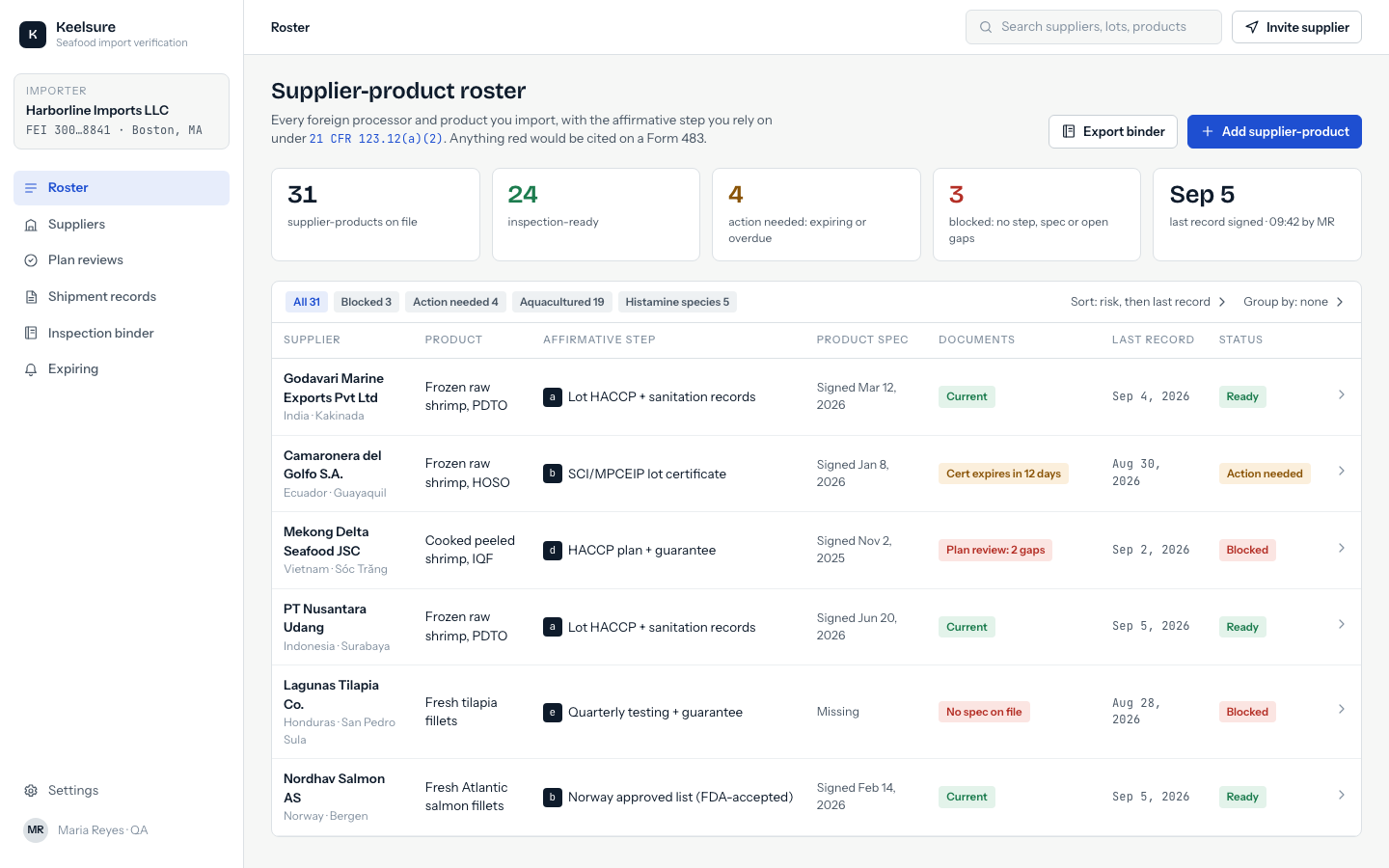
Not a document vault with a seafood label on it. The unit of work is the supplier-product, because that is the unit FDA inspects — and the unit Import Alert 16-119 lists.
The step is a required field — a row cannot exist without one. The single most cited failure in the 2026 letters becomes structurally impossible.
The hazards FDA lists for that species and process — parasites in tilapia, histamine in tuna, aquaculture drugs in farmed shrimp — pre-filled, for you to sign.
Upload a supplier’s plan. In minutes, every hazard the Guide expects, what the plan says about it, and a link to the FDA page it came from.
Procedures, specs, steps, evidence and an append-only log signed and dated at the time of the activity. Expiry sweeps run before a guarantee lapses, not after.

You carry the obligation and none of the leverage. The plant answers the same document request from five American buyers, in a second language, between audits — and the guarantee letter quietly lapses in month thirteen.
They write and maintain their HACCP plan against the Guide, then share it with you directly — once — instead of emailing files to every buyer. Private by default; the plant decides which importers see what. You stop chasing. They stop retyping.
The portal is optional. If a supplier keeps emailing PDFs, Keelsure still tracks them — and still flags the expiry.
This section is here because you will check.
Under 21 CFR 123.10 a trained person must perform the hazard analysis and review the records. Every plan review here requires that person’s attestation before it can be exported or counted.
It reports what is on file and what is missing. It will not tell you, or FDA, that you meet a requirement — that is not a judgment software gets to make.
If the model cannot cite the Guide, it says it could not determine rather than inventing a control. The Guide edition used is stamped on every output.
Consults for FDA on seafood safety and runs HACCP and Good Aquaculture Practices training for processors in exporting countries. He reviews every hazard mapping before it reaches a customer.
Builds the software, and is the person on your first call.
Built the first version of the plan drafter, which is now free for your suppliers to use.
Take one supplier’s HACCP plan — the messiest one you have — and run it against the Hazards Guide for that species. You get every finding, with citations, in minutes. If it finds nothing, that is worth knowing too.
A single page: what §123.12 requires, what FDA cited in 2026, and what Keelsure does and does not do. Written to be forwarded.
Download the one-pager (PDF)